EHK
§ 00 · FOR OPERATIONS LEADERS

The AI toolyour operation actually uses.

Send us your site. We send back the one tool we would build for your operation first, scored in hours saved per week and dollars recovered on a line you already track. Then we walk through it on a short call. The report is free and yours to keep either way.

Built systems at
AmazonAccentureDream Games
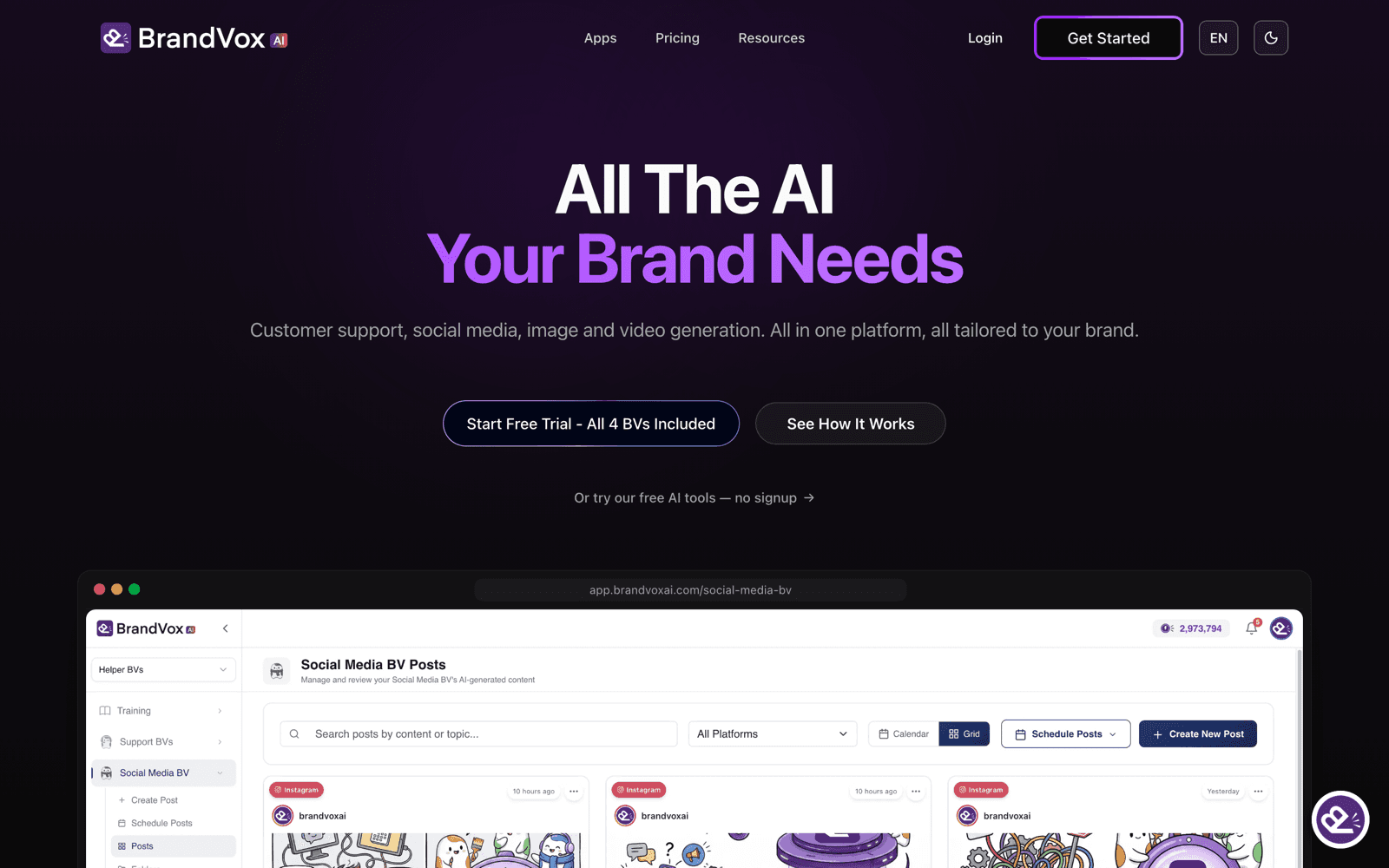
We founded BrandVox AI, an AI product 30+ companies pay for monthly.
DOC · 00SPECIMEN ENCLOSED
Document
AI opportunity report
Prepared for
Your operation
Scored in
Hours saved · dollars recovered
Your cost
$0
The call
30 minutes
Status
Yours to keep
Ege Hakan Karaagac, photographed in Istanbul, 2026.
FIG. 00.BEge Hakan Karaagac · Founder · Istanbul
↓ 01The report
§ 01 · THE REPORT

The report we write for you

If an email from us brought you here, you have already seen this report with your company's name on it. If you have not: we look at how your operation actually runs, we pick the one place AI would earn its keep first, and we write it up. The report is free, and it is yours to keep whether or not we ever work together. We bring it to the call so we can read it together and you can ask the hard questions.

SPECIMEN · FIG. 01.AJune 2026
SPECIMEN REPORT · Illustrative example, not a real client · Figures from public 2025 to 2026 staffing benchmarks
Prepared for

REGIONAL STAFFING CO.

A 90-person regional light-industrial staffing firm (warehouse, packaging, and assembly placements). 6 recruiters on the desk, no AI in use today.

01 · The workflow I watched

Every weekday, inbound applications and resumes land in a shared inbox and the job-board queue. Each recruiter opens them one by one, reads each resume, decides if the person clears the basics for the open order (shift availability, location, lift requirement, certs, right-to-work), and then re-types the useful details into the ATS by hand before anyone can be submitted to the client. On a busy req, that is a couple hundred resumes for one role. The first agency to put a qualified person in front of the client usually wins the placement, so the hours lost reading and re-keying are not just admin. They are placements that walk to a faster competitor while the resume sits unread.

02 · The one tool I would build first

First-Submittal Shortlister

A quiet helper that watches the same application inbox and job-board queue the team already uses. The moment resumes arrive, it reads each one against the open order's real requirements, and hands the recruiter a ranked shortlist of the people worth a call, each with a one-line reason and the key fields already pulled out and dropped into the ATS draft. The recruiter still makes every call and every submit decision. The tool just removes the reading and re-typing, so the qualified people surface in minutes instead of days. Borderline resumes are flagged for a human look rather than auto-rejected, so nobody good gets quietly dropped.

03 · Before and after
SPECIMEN · FIG. 01.CRecruiter time, reading and re-keying resumes
8 HRS BACK / RECRUITER / WK · ×6 = ~48 HRS/WK (~$80,600/YR)TODAY, BY HAND~12 HRSWITH THE TOOL~4 HRS04812 HRS
Todayby hand
Recruiter time reading and re-keying resumes~12 hrs / recruiter / week
Time for a qualified candidate to surface1 to 3 days
Light-industrial orders clients expect filled in 48 hrs61% of clients
Fillable orders lost each week to slower first submittal~2 per week
With the toolhuman still decides
Recruiter time reading and re-keying resumes~4 hrs / recruiter / week
Recruiter-hours returned across the 6-person desk~48 hrs / week (~$80,600 / yr)
Time for a qualified candidate to surfaceminutes, same-morning submittal
Lost orders recovered1 of 2 / week (~$28,000 / yr margin)
04 · Payback
SPECIMEN · FIG. 01.BPayback · build cost vs cumulative value
Q1$0$30K$60K$90K$120KWK 013263952BUILD $20,000CUMULATIVE VALUEYEAR ONE +$108,000PAYBACK · ~WK 10(inside the first quarter)

One recovered placement a week pays for the build on its own in under 10 months. Counting the ~48 recruiter-hours given back each week, the first-year value lands near $108,000, so the build clears its cost inside the first quarter. Numbers are held deliberately at the low end of public benchmarks.

05 · How I would build it
  1. 01Connect to the application inbox and job-board queue you already use (no new system for your team to learn) and read each incoming resume against the open order's real requirements: shift, location, lift, certs, right-to-work, distance.
  2. 02Deliver a ranked shortlist per req within minutes, each candidate with a one-line plain reason, and pre-fill the ATS draft fields so the recruiter stops re-typing.
  3. 03Flag borderline resumes for a human look instead of auto-rejecting, and let recruiters correct the ranking so it matches how your best closer actually screens.
  4. 04Stand up one simple weekly view: hours given back per recruiter, time-to-first-submittal, and orders filled inside 48 hours, so you can see the hours and the placements move.
Assumptions

These figures are illustrative, not a real client's books, and held to the conservative end on purpose. Built from public 2025 to 2026 staffing benchmarks: recruiters spend ~52% of their week on admin and 8 to 10 hours to hand-screen ~200 resumes; teams report 10 to 15 hours per week saved per recruiter from screening automation (this sample claims only ~8); average recruiter cost ~$28/hr, taken to ~$35/hr fully loaded; a submittal not reviewed in 3 days is typically lost; 61% of light-industrial clients expect a 48-hour fill; light-industrial temp gross margin runs ~21 to 25%. Your real numbers replace every figure here on the call.

§ 02 · HOW THIS WORKS

How this works

  1. You send us your site

    One link. No forms to fill out, no data to hand over, no access to anything. We work from what is already public.

  2. We do the homework and write the report

    We read how your operation runs and find the one workflow where AI would pay off first. We write it up, scored in hours saved and dollars recovered, on numbers you already track.

  3. We walk through it on a short call

    Thirty minutes. We bring the report, we read it together, you tell us where we got your operation wrong. You leave with the written report either way.

  4. You decide if you want to go further

    If the report is useful on its own, take it and run. If you want us to build the tool, that is a separate conversation, and only then.

What you have spent by step 04: one link and thirty minutes. Nothing else.

§ 03 · PROOF

What we can actually show you

The work we do is backed by real, running systems. We have built and scaled AI products that real companies rely on and pay for every month, alongside the automation engines that power our own operations.

  1. § 03.01
    BrandVoxAI product we built and run, that companies pay for monthly

    A working AI system with more than 1,000 users; thirty-plus businesses pay between 59 and 449 dollars a month to keep using it. It does the marketing and customer-facing busywork a small team would otherwise grind through by hand: drafting content, answering on chat and social, surfacing leads. The proof here is not a demo. It is that people renew. We build it, run it, and handle the support ourselves, so when we tell you AI can carry real recurring work in your shop, it is because ours already does and the invoices clear every month.

    Under the hood: each customer gets their own private workspace, the AI answers from that customer's own content rather than guessing, and we run and maintain the whole thing on our own infrastructure, by ourselves.

    visit
    ↓ 03.02
  2. § 03.02

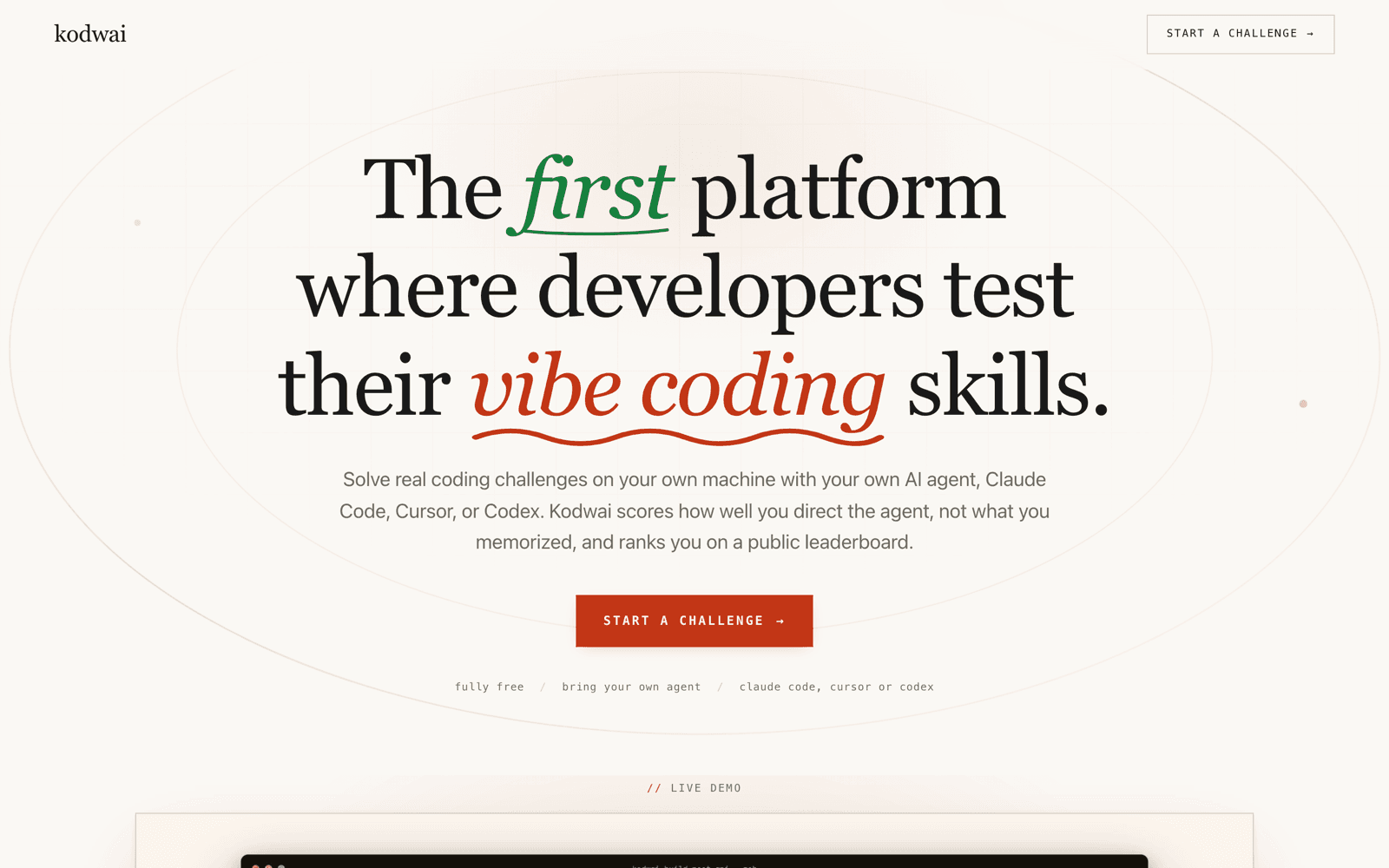
    Kodwai

    AI product we built end to end, live with 50+ developers

    An AI system that sits in for the slow, expensive part of technical hiring: running a structured interview and scoring the answers consistently, so a manager is not reading the same thing forty times and grading it differently by Friday afternoon. More than fifty developers use it today. The point for you is not the hiring use case. It is that we can take a judgment-heavy human workflow, hand the repetitive part to AI, keep a person in control of the call, and get it in front of real users who keep showing up.

    Under the hood: twenty-two live interview scenarios, each scored two ways (a fixed pass-fail check on the things that are either right or wrong, plus an AI read on the judgment calls), with the running cost capped so it never surprises you.

    visit
    ↓ 03.03
  3. § 03.03
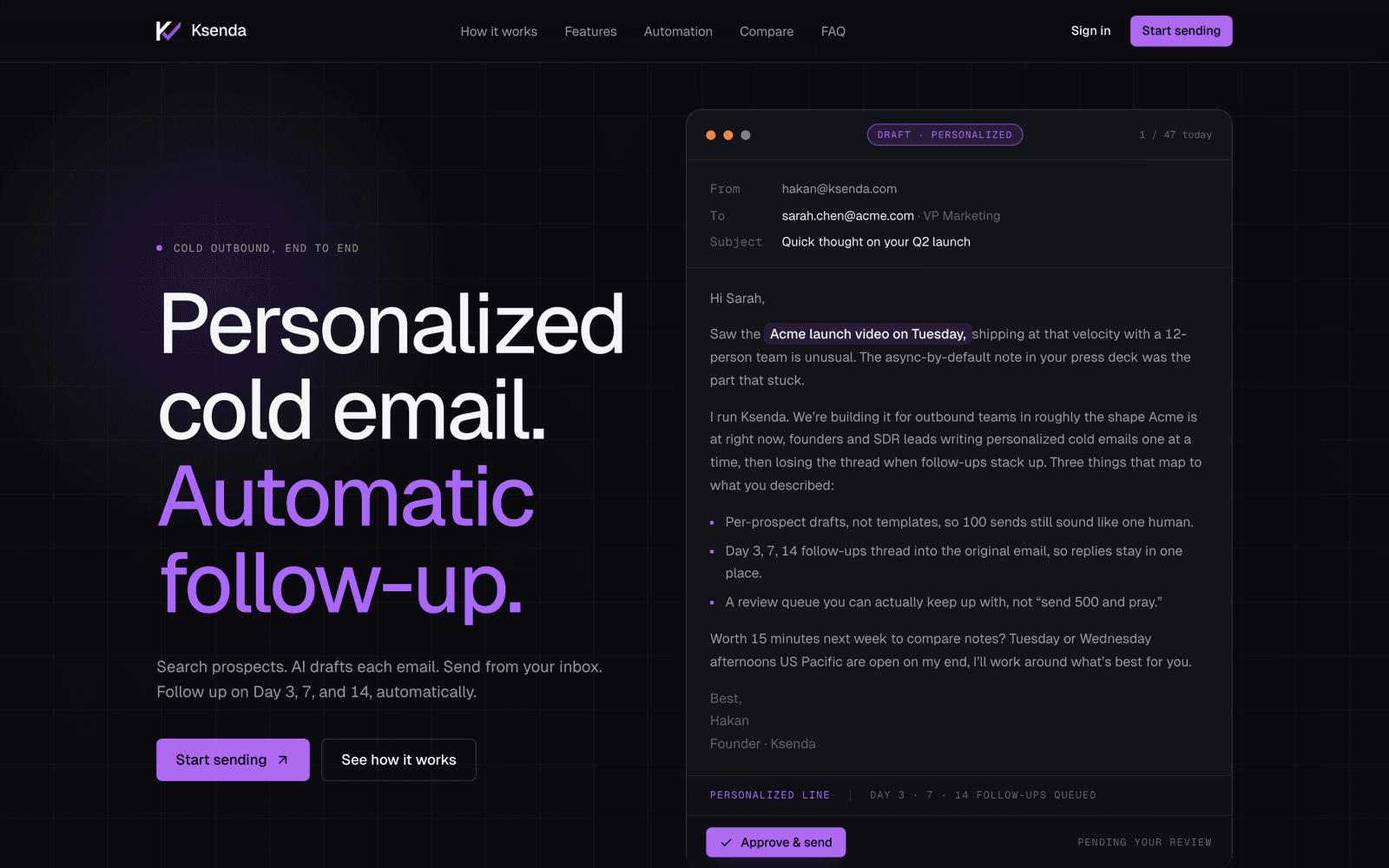
    KsendaThe outbound system that likely sent you here

    If an email from us is what brought you to this page, it came out of Ksenda. This is the one we are most direct about, because we did not just build it, we lived on it. Ksenda is the outbound system we built to find companies worth talking to and reach them one at a time, at a scale a person could never do by hand. We pointed it at our own business and it is how we filled the paying side of BrandVox. Same lesson for you: AI does the prospecting and personalization a junior person would burn forty hours a week on, a human still approves every send, and the numbers come out well ahead of how this normally goes.

    Under the hood: one screen, one click to send, with the AI drafting each message and a required human review step before anything actually goes out the door.

    visit
CASE · 03.AKsenda

The outbound that is normally a full-time job, run by one system we built and one person reviewing

5,000+
emails sent
~15%
reply rate
1 to 5%
industry norm
1 person
reviewing
CASE · 03.B · KSENDAReply rate vs industry norm, real and hand-counted
INDUSTRY NORM 1 TO 5%0%5%10%15%20%~15%≈3 TO 10× NORM5,000+ EMAILS · 1 PERSON REVIEWINGCOUNTED BY HAND, NOT A DASHBOARD
Before

Finding the right companies, writing a relevant first email to each, and chasing the ones who did not reply is the kind of work that quietly takes over a person's whole week. Done properly by hand, researching each prospect, writing something they would actually open, then following up twice without being a nuisance, it is roughly a full-time job for a junior hire, and most of that hire's week goes to copy-paste and list-building, not thinking. The usual payoff for cold outbound is one to five replies per hundred emails.

What I built

We built Ksenda to carry that load and then we ran our own outbound on it. It targets companies by a real signal, drafts a first message tied to something specific about each one, and runs threaded follow-ups on a Day 3, Day 7, and Day 14 rhythm so nobody falls through the cracks. We approve what goes out. Over five thousand emails went through it.

After

About fifteen out of every hundred people replied. The common benchmark is one to five. That is roughly three to ten times the normal return on the same effort, and the effort itself collapsed: the hours a person would have spent building lists and hand-writing first drafts came off the table. Reply tracking is read by hand, so the fifteen percent is a number we counted, not one a dashboard flattered us with.

Why this is proof for you

This is an operations result, not a marketing stat, and it is ours. We took a workflow that normally costs a team a full salary in manual hours, removed the manual hours, and lifted the response rate several times over. It is also the strongest proof we can offer that we ship working AI, because the result we are selling you on is the result it produced for us. We built it, we ran it, we counted the replies, and it is how we got the customers who pay us now.

§ 04 · SAFE HANDS

Safe hands

Before founding the company, Ege Hakan Karaagac spent two years at Amazon on the systems that ran checkout and tax for millions of orders, the kind that has to be right every single time, then backend at Dream Games, and Accenture before that. We are a close team in Istanbul, on purpose, so you deal with the people doing the work and not a handoff to someone junior. We build things to keep running after we step away, because that is the only kind of work we are trained to ship. The code and the accounts are yours from day one, written plainly enough that any normal engineer can pick them up.

  1. 2024 to now
    BrandVox AI
    Delaware / Istanbul (remote)
    Founder

    Our own company. The AI products in the proof section above: built, run, and supported by us, and paid for monthly by real businesses.

  2. 2024
    Dream Games
    Istanbul, TR
    Backend Engineer

    High-throughput services behind one of the top-grossing mobile games. Istanbul.

  3. 2022 to 2024
    Amazon
    Luxembourg City, LU
    Software Development Engineer

    Checkout and Tax systems, the ones that move customer money and have to be right every time. Luxembourg.

  4. 2022
    Accenture
    Istanbul, TR
    Developer Analyst

    Backend for an enterprise customer-experience platform. Istanbul.

  5. 2017 to 2022

    Bilkent University

    Ankara, TR
    BS, Computer Science

    Four-year computer science degree.

§ 05 · STRAIGHT ANSWERS

Straight answers

01Is this just more AI hype?
Fair question, and you are right to be tired of it. We are not going to pitch you a future. We pick one workflow you already run, inside your own operation, where the work is repetitive and slow, and we build the thing that does it. You see it running on your data before you decide anything. The free report we bring to our call names that one workflow and what it would save, in hours per role per week and dollars, not in adjectives. If the number is not worth your time, you say so and we are done.See for yourself: the sample report above
02Will this even work in our industry when we have no AI today?
Having no AI today is the normal starting point, not a problem. Most of the companies worth doing this for are operations-heavy and have not deployed anything yet. The work we do does not care whether you are a staffing firm, a clinic, a distributor, or a manufacturer. It cares whether there is a task your team repeats every day that eats hours: chasing the same information, re-keying the same data, drafting the same replies, catching the same errors after the fact. That pattern is in every operation. The report we bring is written for your workflow specifically, so on the call you can judge fit for yourself rather than take our word that it transfers.
03Who owns the code and the accounts?
You do, from day one. The code is built in your repository and the accounts are set up in your name with your billing. We work inside them. We do not hold them hostage. There is no platform you have to keep renting from us, and nothing breaks if we stop working together. If you want to hand the whole thing to your own team or another engineer later, everything is already sitting where it belongs, in your possession. We will put that in writing before any work starts.
04What if it does not save the hours you claim?
Then the number was wrong and we both want to know that early. This is why the order is what it is. Before any build, the report puts a specific estimate on the table, in hours and dollars, with the assumptions written out so you can argue with them. During the build, you see it running on real work, so the saving is something you measure, not something we assert. If it is not landing near the estimate, that shows up in week one or two, not at the end. We would rather tell you a workflow is not worth automating than bill you to find that out.The assumptions are written out under the sample report
05You are a small team, overseas. What happens after you hand it off?
Real question. We are a small team in Istanbul, and we work this way on purpose so you are dealing with the people doing the work, not a handoff to someone junior. The continuity risk is handled by how we leave things, not by promises about us. The code and accounts are yours from day one, written plainly and documented so a normal engineer can pick it up, with no part that only we understand. You are never locked to our availability. If you want ongoing help we offer a monthly arrangement, but that is a choice, not a dependency. Our founder's background is Amazon, where he worked on checkout and tax, the systems that take customer money and have to be correct every single time.The record: three running products and the employment history above
06Where does our data go, and what about privacy and compliance?
It stays in accounts you own, under your control. The setup runs in your name, so your data sits with your providers, not on some service of ours that you cannot see into. We do not move your records to our own systems or keep copies after the work is done. We will tell you plainly which outside services any part of the work touches and what gets sent to them, so you and your compliance people can sign off before anything is connected, not after. If a workflow involves records that have rules around them, we scope it so those rules are respected, or we leave that piece alone. You will always know where your data is, because it never leaves your hands.
§ 06 · IF YOU WANT TO GO FURTHER

If you want to go further

This comes after the report, and only if you want it. Most of the value is in the report itself, which costs you nothing. If you decide to build, there are two ways to work with us. No third option, no upsell ladder. If neither is right yet, the report is still yours to keep and we leave it there.

Build the first tool

about 6 weeks
Best for

You read the report, you want that first tool live and saving hours.

What you get
  1. 01The one tool from your report, built and running inside your real workflow
  2. 02Set up to measure the hours and dollars it actually moves, not a guess
  3. 03Your team trained to use it, with plain documentation
  4. 04The code is yours, handed over so you are never locked to us

Keep us on the bench

month to month, 3-month minimum
Best for

You have more than one place AI could help and want a steady hand on it.

What you get
  1. 01A set share of our week, every week, on your roadmap
  2. 02We work down your list one real workflow at a time
  3. 03We keep what is already live running and improving
  4. 04Cancel after the minimum with thirty days notice
§ 07 · CONTACT

Book the walk-through

Pick a time that works. We will have read your operation before we talk, and we will bring the written report to the call. Thirty minutes, peer to peer, no slides. If you would rather just read the report first, email us your site and we will send it over, no call needed.

Ege Hakan Karaagac, photographed in Istanbul, 2026.
FIG. 00.BEge Hakan Karaagac · Founder · Istanbul

We are a team founded by Ege Hakan Karaagac. He spent two years at Amazon building the systems that ran checkout and tax for millions of orders, then backend at Dream Games, before that Accenture. We now build AI products of our own: BrandVox, with more than 1,000 users and 30-plus paying every month, and Kodwai, an AI interview platform more than 50 developers use. We built Ksenda, the cold-email system that brought you here, and ran it on our own outbound: more than 5,000 emails, about 15 percent reply against an industry norm of 1 to 5 percent. We do one thing for clients. We find the first place AI earns its keep in your operation, and we build it.

REV. 2026.06 · EHK-LANDING-B© 2026 EGE HAKAN KARAAGAC ·↑ TOP